

The global race toward faster and more reliable mobile connectivity has accelerated in recent years, and at the center of this transformation is the 5G spectrum auction. Governments around the world are allocating radio frequencies to telecom operators through auctions, enabling the deployment of fifth-generation mobile networks. These auctions not only determine which companies can operate 5G services but also shape the future of digital economies, smart cities, and next-generation technologies.
What Is a 5G Spectrum Auction?
A 5G spectrum auction is a government-organized process where telecom companies bid to acquire licenses for specific radio frequency bands used to deliver 5G services. Spectrum refers to the invisible radio waves that carry wireless signals for mobile phones, internet connections, and other communication technologies.
Because spectrum is limited and extremely valuable, governments allocate it through competitive auctions. Telecom operators compete by placing bids for different frequency bands, and the highest bidders receive the rights to use those frequencies for a defined period, often 15–20 years.
These auctions play a critical role in determining how quickly and efficiently 5G networks can roll out across a country.
Why the 5G Spectrum Auction Matters
The 5G spectrum auction is far more than a regulatory process. It directly impacts how quickly users experience faster mobile speeds, lower latency, and improved connectivity.
Here are several reasons why these auctions are important:
1. Accelerating 5G Deployment
Telecom companies cannot launch full-scale 5G services without spectrum licenses. Once the auction is completed, operators can begin building infrastructure such as towers and base stations to activate their networks.
2. Boosting Economic Growth
Studies show that 5G technology can add trillions of dollars to the global economy. A successful 5G spectrum auction allows industries such as manufacturing, healthcare, transportation, and agriculture to benefit from automation, IoT, and real-time data.
3. Improving Consumer Experience
For everyday users, the impact of a 5G spectrum auction translates into faster downloads, smoother video streaming, lag-free gaming, and improved mobile connectivity even in crowded areas.
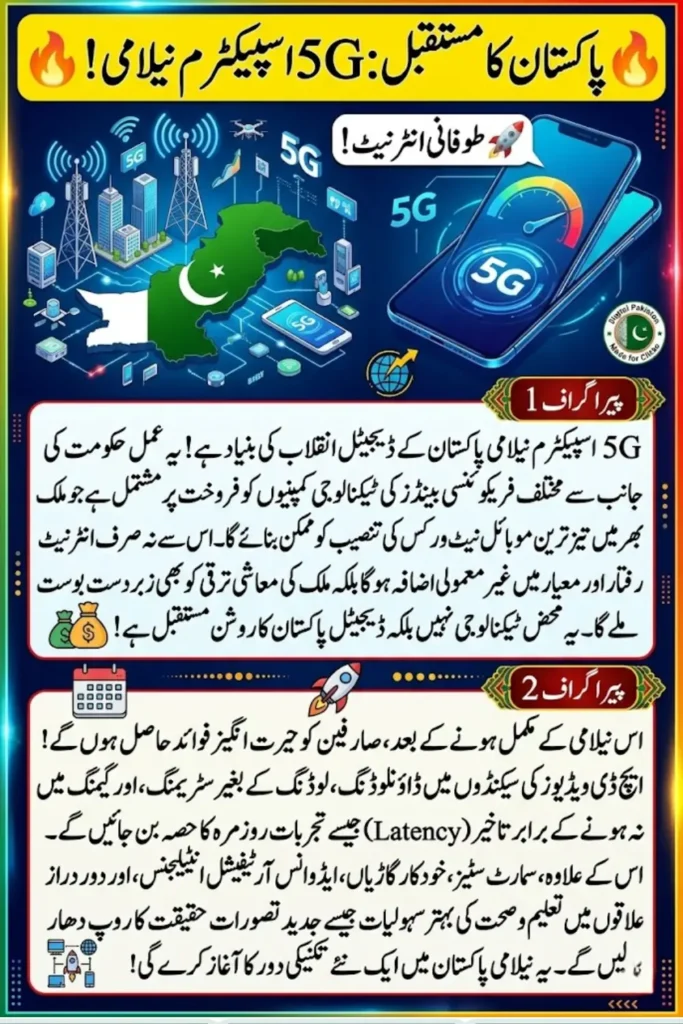
Types of Spectrum Used in 5G Auctions
Not all spectrum frequencies perform the same. During a 5G spectrum auction, governments typically offer several types of frequency bands:
Low-Band Spectrum (Below 1 GHz)
Low-band frequencies provide wide coverage and strong signal penetration through buildings. However, they offer relatively slower speeds compared to other bands.
Mid-Band Spectrum (1–6 GHz)
Mid-band spectrum strikes a balance between coverage and speed. It is widely considered the backbone of most national 5G networks.
High-Band Spectrum (Millimeter Wave)
High-band spectrum delivers extremely fast speeds and ultra-low latency. However, its coverage area is limited and requires more infrastructure.
Each of these bands plays a different role in building a strong and efficient 5G ecosystem.
How a 5G Spectrum Auction Works
The process behind a 5G spectrum auction typically follows several steps:
1. Government Planning
Regulators analyze available frequencies and decide which bands will be offered to telecom operators.
2. Setting Reserve Prices
Authorities set a minimum price for each spectrum block to ensure fair competition and maximize national revenue.
3. Bidding Process
Telecom companies submit bids for desired spectrum blocks. Multiple rounds may occur until the highest bid is determined.
4. License Allocation
Winning bidders receive licenses that grant them the right to operate services using that spectrum for a specific period.
This structured process ensures transparency and fair access for competing telecom providers.
Challenges in 5G Spectrum Auctions
Despite their importance, 5G spectrum auctions also come with challenges for governments and telecom operators.
High Costs for Telecom Companies
Spectrum licenses can cost billions of dollars. In some countries, high auction prices have slowed network expansion because operators must balance spectrum costs with infrastructure investment.
Infrastructure Requirements
After a 5G spectrum auction, telecom companies must invest heavily in network equipment, fiber connections, and towers to activate their services.
Regulatory and Policy Issues
Governments must carefully design auction rules to avoid monopolies and ensure fair competition among operators.
Global Trends in 5G Spectrum Auctions
Countries worldwide are conducting 5G spectrum auctions as part of their digital transformation strategies. The United States, South Korea, China, and several European nations have already allocated significant spectrum resources to telecom providers.
In many emerging markets, upcoming auctions are expected to accelerate 5G adoption and expand mobile broadband access. Governments are also exploring innovative auction models to balance revenue generation with rapid network deployment.
The Future After the 5G Spectrum Auction
Once the 5G spectrum auction process is completed, the real transformation begins. Industries will start leveraging ultra-fast connectivity to power technologies such as autonomous vehicles, smart factories, remote surgery, and advanced artificial intelligence applications.
For consumers, this means a future where connectivity is faster, more reliable, and deeply integrated into everyday life. From smart homes to connected transportation systems, the impact of 5G will reshape how people live and work.
Final Thoughts
The 5G spectrum auction is one of the most critical steps in building the digital infrastructure of the future. By allocating valuable radio frequencies to telecom operators, governments enable the expansion of next-generation networks that support innovation, economic growth, and technological advancement.
As more countries complete their 5G spectrum auctions, the world moves closer to unlocking the full potential of 5G connectivity. Businesses, governments, and consumers alike stand to benefit from a faster, smarter, and more connected digital landscape.
Complete Method to Conduct NSER Survey Through BISP Office